Brave Genius by Sean B. Carroll
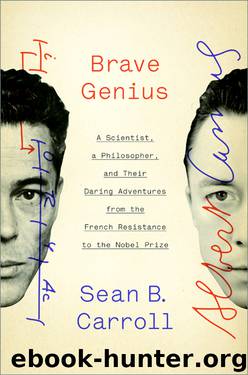
Author:Sean B. Carroll [Carroll, Sean B.]
Language: eng
Format: epub, azw3, mobi
ISBN: 978-0-307-95235-6
Publisher: Crown Publishing Group
Published: 2013-09-24T04:00:00+00:00
He and Monod had a lot to talk about.
CHAPTER 20
ON THE SAME PATH
A man’s growth is seen in the successive choirs of his friends.
—RALPH WALDO EMERSON, “Circles”
MONOD AND CAMUS HIT IT OFF RIGHT AWAY. CAMUS WANTED TO hear about Monod’s experiences as a Communist during the war and what Monod had learned about Lysenko. Monod in turn learned that Camus had been devoting a great deal of study to the situation in the Soviet Union. The two former resistants discovered an immediate bond in their respective condemnation of Stalin’s regime. Their friendship was cemented over drinks and conversation at La Closerie des Lilas and other Left Bank watering holes.
Camus had reached a conclusion similar to Monod’s about the “mortal decay” of Socialist thought in the Soviet Union, but his verdict was based on different evidence. One catalyst for Camus’s decisive turn against Soviet-style Communism was his meeting the ex-Communist writer Arthur Koestler. Born in Hungary, Koestler lived in Vienna, Berlin, Palestine, and Paris between the wars. A Communist activist for several years, Koestler quit the Party in 1938 over what he described as its “moral degeneration,” which was marked by Stalin’s purges of loyal Party members and Moscow show trials. From 1936 to 1938, hundreds of thousands of Russians were executed and millions were sent to labor camps. Even former revolutionary leaders were tried and forced to confess to absurd, fabricated charges. Koestler knew some of the defendants. His disgust and disillusionment gave birth to his novel Darkness at Noon, in which the lead character, Rubashov, eventually confesses to false charges and is executed. The book was a sensation in France after the war, selling more than 300,000 copies in less than two years.
Koestler visited Paris in October 1946, and met Camus simply by walking into his office at Gallimard and introducing himself. Koestler tracked down Sartre the next day. He was welcomed immediately into the Camus–Sartre–de Beauvoir social circle. At the time, Camus was in the process of writing “Neither Victims nor Executioners” for Combat. Camus paid close attention to what Koestler had to say, especially when he chided Camus for having been too lenient on the Soviet Union. Koestler’s break from his Communist past was complete. At a meeting with Sartre and others at André Malraux’s home, Camus carefully noted what was said among his famous friends. Koestler said that he hated the Stalin regime as much as he hated the Hitler regime, and for the same reasons. He had once lied for Stalin, he admitted, but now he was certain there was no hope for the regime. Koestler added, “It must be said that as writers we are guilty in the eyes of history if we do not denounce what deserves to be denounced. The conspiracy of silence is our condemnation in the eyes of those who come after us.”
Camus would not be silent. His encounter with Koestler hardened his conviction that Communism and Stalinism were the greatest immediate threats to peace in Europe—they were the new plague.
Download
Brave Genius by Sean B. Carroll.azw3
Brave Genius by Sean B. Carroll.mobi
This site does not store any files on its server. We only index and link to content provided by other sites. Please contact the content providers to delete copyright contents if any and email us, we'll remove relevant links or contents immediately.
| Afghan & Iraq Wars | American Civil War |
| American Revolution | Vietnam War |
| World War I | World War II |
Waking Up in Heaven: A True Story of Brokenness, Heaven, and Life Again by McVea Crystal & Tresniowski Alex(37815)
Empire of the Sikhs by Patwant Singh(23090)
We're Going to Need More Wine by Gabrielle Union(19053)
Hans Sturm: A Soldier's Odyssey on the Eastern Front by Gordon Williamson(18596)
Leonardo da Vinci by Walter Isaacson(13341)
The Radium Girls by Kate Moore(12036)
Tools of Titans by Timothy Ferriss(8403)
Educated by Tara Westover(8060)
How to Be a Bawse: A Guide to Conquering Life by Lilly Singh(7493)
Permanent Record by Edward Snowden(5852)
The Last Black Unicorn by Tiffany Haddish(5643)
The Rise and Fall of Senator Joe McCarthy by James Cross Giblin(5284)
Promise Me, Dad by Joe Biden(5157)
The Wind in My Hair by Masih Alinejad(5103)
A Higher Loyalty: Truth, Lies, and Leadership by James Comey(4967)
The Crown by Robert Lacey(4820)
The Iron Duke by The Iron Duke(4367)
Joan of Arc by Mary Gordon(4117)
Stalin by Stephen Kotkin(3973)
